

Quick Summary
Custom screen printing is best for large runs of one design, while DTF suits small orders and full-color art. Compare itemized quotes for setup, artwork and rush fees, confirm minimums, and approve a proof before printing. Shirtz Plus, an El Paso printer, offers both DTF and screen-printing-style services.
- Screen printing lowers the per-shirt cost on large runs of a single design.
- DTF handles full-color art and small quantities with minimal setup.
- Request itemized quotes that list setup, artwork and rush fees separately.
- Get a written production date and approve a proof before printing starts.
- Shirtz Plus states it has no minimum order requirements, so confirm the terms.
Table of Contents
- What Makes a Professional Custom Screen Printing Service
- Custom Screen Printing vs DTF Printing: Which Method Fits Your Order
- Screen Printing Artwork Requirements and File Preparation
- Screen Printing Turnaround Time and Order Minimums
- Provider Comparison: Pricing, Minimums and Service Options
- Reviewing Professional Custom Screen Printing Services: A Buyer Checklist
- Requesting Your Quote from Shirtz Plus for Your Next Order
- Frequently Asked Questions
Professional Custom Screen Printing Services: A Buyer's Review
Last Updated: November 22, 2026
Choosing a custom screen printing service is harder than it looks. Many shops quote a low price per shirt, then add setup fees, artwork charges and rush surcharges that change the total. A clear comparison of methods and buying criteria helps you avoid that.
Screen printing presses ink through a stencil onto each garment, one color at a time. It works best for large runs of a single design.
What Makes a Professional Custom Screen Printing Service
A professional service does more than print. It checks your artwork, confirms colors before production and tells you the total cost up front. It also explains how your order will be made.
Look for these qualities when you compare providers:
- Clear order minimums. Ask whether there is a minimum quantity and what it is. If you only need one design, you can order a single custom DTF print without committing to a large run. A provider with no minimums can take a small reunion order as well as a larger team run.
- Itemized quotes. Setup, artwork, garment and rush fees should appear separately. A single low number often hides these costs.
- Proof approval. You should see a proof or digital mockup before anything prints.
- Realistic turnaround. Ask for a production date, not a vague promise.
Shirtz Plus offers full-service printing, print-and-press options and mobile printing for on-site events. It also advertises no minimum order requirements and fast turnaround. Check those terms against your own quote before you commit.
Custom Screen Printing vs DTF Printing: Which Method Fits Your Order
Screen printing and DTF are both common for custom apparel, but they behave differently in cost, color and durability.
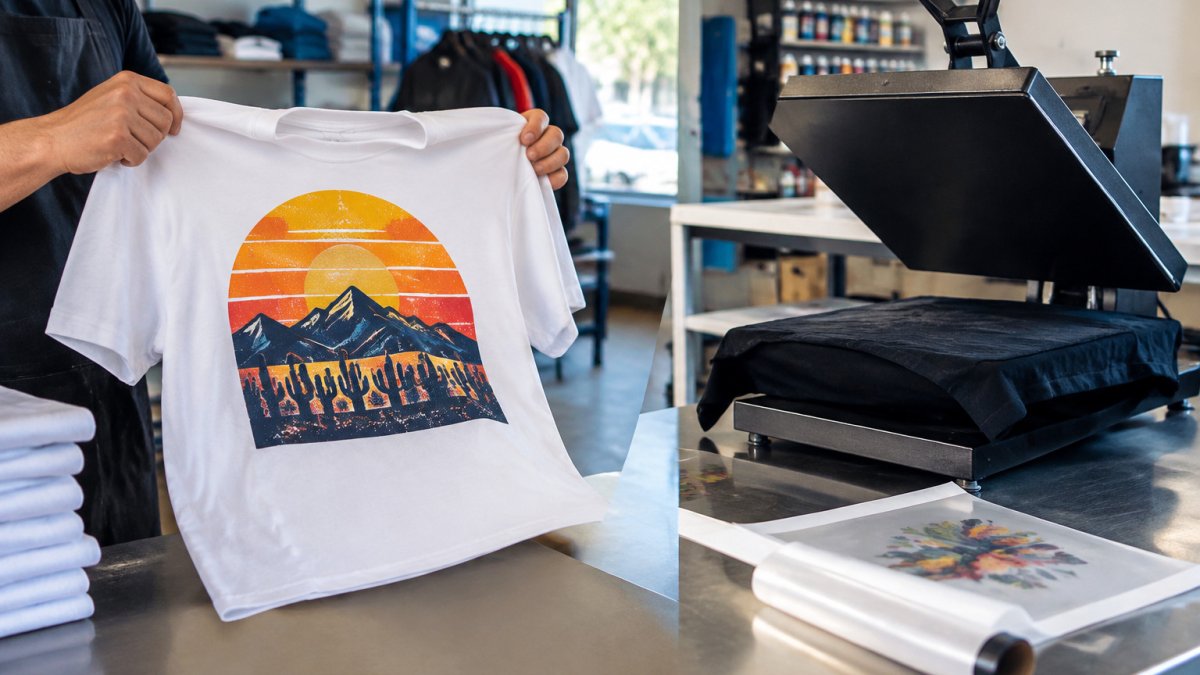
Screen printing usually costs less per shirt on large runs. The stencil and setup have to be made first, so small orders carry more cost per piece.
A useful rule: if you are printing a few dozen shirts with a complex, full-color design, DTF is often the better fit.
Feature Breakdown: Screen Printing vs DTF
| Factor | Screen Printing | DTF Printing |
|---|---|---|
| Best order size | Large, single-design runs | Small runs and mixed designs |
| Color detail | Limited by number of color passes | Full-color, photo-style art |
| Setup cost | Higher, due to stencils | Low, minimal setup |
| Feel on garment | Ink sits in the fabric | Thin film layer on the surface |
| Turnaround | Longer on setup-heavy jobs | Usually quicker for small jobs |
Pros of screen printing: lower per-piece cost on big runs, a soft ink feel on many fabrics, and reliable results on simple designs.
Cons of screen printing: setup costs make small orders expensive, and each added color adds a step.
Pros of DTF: full-color designs, easy small runs and a clean setup for gang sheets.
Cons of DTF: the transfer film sits on top of the garment, so the feel can differ from screen-printed ink.
Shirtz Plus lists a Custom DTF Print (Single Image) at $3.50, a Custom DTF Print 12x36 (Gang Sheet) at $19.99 and a Custom DTF Print 12x72 (Gang Sheet) at $39.99. You can use the gang sheet builder to lay out your designs before ordering.
Screen Printing Artwork Requirements and File Preparation
Clean artwork prevents delays and print problems. Vector art scales without losing sharpness and makes color separation easier. Raster files such as photos can still work, but they often need more preparation.
Before you send your design, check these points:
- File type. Vector formats such as AI, EPS or SVG scale cleanly. High-resolution PNG or PDF files are common for print work.
- Color count. Tell the printer how many colors the design uses. Each extra color adds a screen and a production pass.
- Background. Use a transparent background unless you want a shape printed on the garment.
- Size. Confirm the print area and send art at the final size, or at least at the required resolution.
- Mirroring. Some print files may need to be flipped before printing. Check the product notes for mirroring instructions.
If you do not have artwork, ask the shop whether it offers design help. Confirm any design service charge in writing before you approve the work.
Quality Assurance You Can Ask For
Artwork preparation is only half the job. The other half is proving the print will hold up. Ask providers these quality questions before you approve a large order:
- Proofing. Ask whether you will receive a proof showing placement, size and colors before printing. A proof on a white background can hide problems on dark garments.
- Color matching. Ask whether the provider can match a specific color reference, and whether there is a charge for a custom mix.
- Registration. On multi-color prints, ask how the provider checks that colors align.
- Wash testing. Ask whether the provider tests wash durability on the ink and garment combination you chose.
- Inspection. Ask what the provider inspects before shipping: print placement, color accuracy, garment defects and count.
Matching the Method to the Artwork
Artwork requirements change with the method. Screen printing works well with simple designs that use a few colors. DTF handles full-color art and fine detail, which is why it suits small runs and complex designs. If your art has gradients, tiny text or many colors, ask whether DTF is the better fit before you pay for screen setup.
Confirm the file requirements in writing before you upload.
Screen Printing Turnaround Time and Order Minimums
Turnaround and minimums decide whether a provider fits your deadline and budget. A shop that prints by the dozen behaves differently from one that accepts a single shirt.
Turnaround depends on the method, the order size and the design, so ask each provider for a production date.
Ask every provider these questions:
- What is the minimum order quantity for each method?
- Is there a rush or same-day option, and what does it cost?
- When does production start after I approve the proof?
- How will the order be delivered, and does pickup or local delivery cost extra?
Shirtz Plus states that it has no minimum order requirements and offers same-day and rush service on select orders.
Provider Comparison: Pricing, Minimums and Service Options
Provider pages often list services without an easy way to compare them side by side. A neutral comparison framework fixes that.
Use the same order brief for every provider: the same quantity, garment style, color count, print size and deadline. Then score each quote against the criteria below. This keeps the comparison fair and exposes hidden costs.
Comparison Criteria That Actually Change the Total
| Criterion | What to ask | Why it matters |
|---|---|---|
| Minimum order | Is there a minimum quantity per design or per method? | A low per-piece price with a high minimum can cost more than a flexible short run. |
| Setup and screen fees | Are setup fees charged per color, per screen or per order? | Setup is often the largest hidden cost on small screen-printing runs. |
| Artwork and proofing | Is artwork preparation included, and is a digital proof standard? | Missing proofing leads to reprints and missed deadlines. |
| Color matching | Can the provider match a specific color reference, and is there a charge? | Exact brand colors may require a custom mix or a different method. |
| Turnaround | What is the production date after proof approval, not the order date? | Vague turnaround promises are the most common cause of late event orders. |
| Rush options | Is rush service available, and what qualifies? | Rush capacity varies by method and order size. |
| Delivery and pickup | Are pickup, local delivery or shipping included or extra? | Delivery fees can erase a lower per-piece quote. |
| Reprint policy | What happens if the print does not match the approved proof? | A clear policy protects you on large orders. |
A Simple Scoring Method
Give each provider a score from 1 to 5 on each criterion, then weight the criteria that matter most for your order. For a tight event deadline, weight turnaround and rush options higher. For a large team order, weight per-piece price, setup fees and reprint policy higher.
This scoring approach turns a pile of quotes into a decision you can defend.
Service Options Beyond the Print
Service options matter as much as price. Mobile printing can suit events where guests want shirts on the spot.
Shirtz Plus offers custom shirts, hoodies, hats, DTF transfers, banners and stickers, with full-service printing, print-and-press and mobile printing units for events.
Watch out: a provider that will not put the production date and reprint policy in writing is a risk on any deadline-driven order, regardless of price.
Reviewing Professional Custom Screen Printing Services: A Buyer Checklist
Use this checklist before you approve any order:
- I know my quantity and whether the provider has a minimum.
- I have compared quotes using the same garment, colors and deadline.
- The quote lists setup, artwork and rush fees separately.
- I have a written production date, not only an estimate.
- I will approve a proof before printing starts.
A reliable provider answers these points without hesitation. If a shop avoids a question about fees or timing, treat that as a warning sign and ask again in writing.
Shirtz Plus has worked with local teams and organizations, including Texas Select VBC, EP Texans Football, Bettyes Healthcare Network, El Dorado HS Aztec Volleyball and UTEP Accounting Society. Ask any provider you consider for examples of similar past work, and check that they match the type of order you need.
Requesting Your Quote from Shirtz Plus for Your Next Order
If you are ready to compare options, start with a clear brief. Include your quantity, garment type, number of colors or design complexity, deadline and delivery location.
If your order is a single design or a multi-design sheet, the Custom DTF Print (Single Image) or the Custom DTF Gang Sheet Builder (Auto) may be a good place to start.
Shirtz Plus is based in El Paso and offers local delivery and mobile printing for events.
Frequently Asked Questions
How do I choose a professional screen printing service?
Start with the work you need printed. Ask whether the shop handles your garment types, how many colors it prints at a time, and whether it offers a sample or proof before the full run. Check its order minimums, turnaround time and how it handles reprints if colors or placement are off. A shop that answers these questions in writing, with a clear quote, is usually a safer bet than one that quotes only a low headline price. Compare two or three providers on the same order so the differences are easy to see.
Is screen printing or DTF better for custom shirts?
Screen printing usually works better for large runs of the same design on cotton shirts, because the cost per shirt drops as quantity rises. DTF, or direct-to-film transfer printing, handles full-color designs, small batches and mixed garment types well, and it does not need a separate screen for each color. For a single shirt or a short run with many colors, DTF often makes more sense. For a team order of 50 identical shirts with two or three colors, screen printing is typically the stronger choice.
What artwork file is best for screen printing?
Vector files such as AI, EPS or SVG are preferred because they scale without losing sharpness and make color separation easier. High-resolution PNG or PDF files also work when vector art is not available. Send the design at actual print dimensions, with a transparent background. Ask the shop whether it charges for artwork setup before you order.
How long does custom screen printing take?
Turnaround depends on order size, the number of colors, the garment supply and how quickly the artwork is approved. Simple, small orders can move faster than large multi-color runs that require multiple screens and curing passes. Ask for a written turnaround estimate that starts from proof approval, not from the day you first call. Shirtz Plus offers same-day and rush service on select orders and has no minimum order requirements, which can help if your event is close.
