

Last Updated: November 19, 2026
Quick Summary
DTF vs DTG comes down to fabric first: DTF wins on blends, polyester, dark garments and detailed full-color art, while DTG wins on 100% cotton when you want the print to sit soft in the fibers. Neither process is universally better, so match the process to the fabric, then to the design.
- DTF bonds to cotton, polyester, blends, nylon and fleece; DTG works on cotton and cotton-heavy blends.
- DTG needs a white underbase and pretreatment on dark garments, while DTF does not.
- Cold water is the single biggest lever for extending print life on either process.
- Many designs on few shirts favor DTF gang sheets, since you pay per sheet rather than per image.
- Photographic images, gradients, fine linework and small text are best suited to DTF.
Table of Contents
- DTF vs DTG Printing for Custom Shirts: The Short Answer
- DTF vs DTG at a Glance: Comparison Table
- DTF and DTG Fabric Compatibility
- DTF vs DTG Print Feel: Soft Hand vs Transfer Layer
- DTF vs DTG Printing Which Lasts Longer
- Cost Per Print: Transparent Math for Small and Bulk Orders
- DTF Transfer for Custom Shirts: When It Beats DTG
- Get a Quote for Your Custom Shirt Order
- Frequently Asked Questions
DTF vs DTG Printing for Custom Shirts: The Short Answer
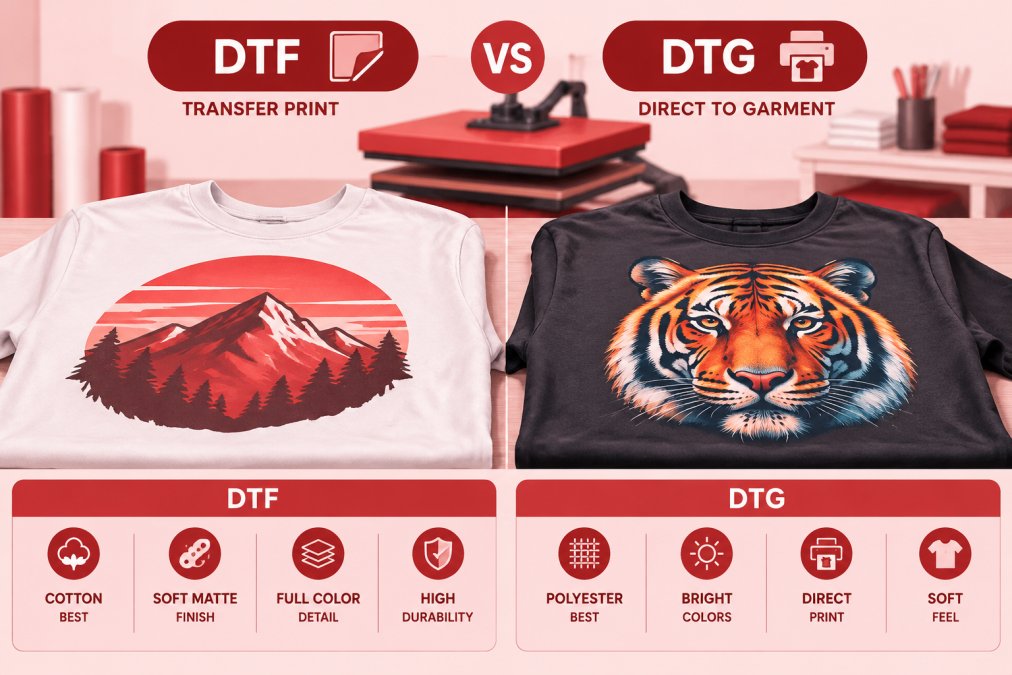
For most custom shirt orders, the right process depends on fabric and design. DTF (direct-to-film) wins on blends, dark garments, and detailed full-color art. DTG (direct-to-garment) wins on 100% cotton when you want the print to disappear into the fabric. Neither process is universally better.
The one-line rule we give people: match the process to the fabric first, then to the design. Most bad print outcomes trace back to forcing a process onto the wrong garment.
Below, we break down how each method works, how they feel and wear, what they cost per print, and which designs belong on which process.
How Each Process Works
DTF printing works in reverse: the design prints onto a transfer film, gets coated with adhesive powder, cures, and presses onto the garment with heat. The film peels away, leaving a flexible printed layer bonded to the fabric.
DTF vs DTG at a Glance: Comparison Table
The table below summarizes the practical differences. Use it as a quick reference, then read the sections that match your order.
| Factor | DTF | DTG |
|---|---|---|
| Fabric range | Cotton, polyester, blends, nylon, fleece | Cotton and cotton-heavy blends |
| Dark garments | Strong, no pretreatment needed | Needs white underbase and pretreatment |
| Print feel | Thin transfer layer, slightly raised | Soft hand, ink sits in the fibers |
| Image detail | Excellent on fine detail and gradients | Strong, but can soften on textured fabric |
| Setup for small batches | Fast, no per-garment prep | Pretreatment adds a step per shirt |
| Best for | Blends, darks, mixed-fabric orders | 100% cotton, light garments, soft feel |
DTF and DTG Fabric Compatibility
Fabric compatibility is the biggest decision factor and where most buying mistakes happen. DTF bonds to a wide range of fabrics because the adhesive layer, not the fiber, does the holding.
Cotton, Polyester and Blends
- 100% cotton: DTF gives sharp edges and bright whites on dark colors.
- Cotton/poly blends: DTF bonds well across blended fabrics.
- 100% polyester: DTF is suitable for polyester garments.
- Fleece and nylon: DTF handles both.
If your order mixes fabrics, team jerseys in polyester, coach shirts in cotton, DTF lets you print everything from one transfer run. That consistency matters more than most buyers expect.
For a cotton blank that suits DTG, the Gildan 64000 Softstyle tee is a 100% ring spun cotton option. For tri-blend jobs where either process can work, the Port Co PC330 tri-blend tee gives you flexibility.
DTF vs DTG Print Feel: Soft Hand vs Transfer Layer
DTF leaves a thin but detectable layer. On a quality transfer it is flexible and light, not the stiff plastic patch people remember from old heat transfers. Still, run your hand across it and you will feel the edge.
DTF vs DTG Printing Which Lasts Longer
Durability is where most online comparisons get vague. Here is the mechanism-level breakdown, plus the wash variables that determine whether a print survives twenty cycles or two.
Why DTF and DTG Fail Differently
DTF is an adhesive bond. The printed transfer layer sits on top of the fabric, held by a heat-activated powder adhesive.
The Wash Variables That Matter More Than the Process
Wash habits affect how long any printed garment keeps its look.
- Water temperature: Hot water accelerates ink breakdown and adhesive softening. Cold water is the single biggest lever for either process.
- Dryer heat: High heat can shorten the life of a printed garment. Air drying or low heat helps extend it.
- Inside-out washing: Turning the garment inside out reduces direct abrasion against the print, which matters more for DTF because the transfer layer is exposed.
- Detergent type: Powdered detergents with abrasive granules can scratch a DTF transfer surface. Liquid detergent is gentler on both.
- Wash frequency: Overwashing is common. Spot cleaning between wears extends print life more than any care label instruction.
If you press your own transfers, verify cure temperature and dwell time against the film manufacturer's specification.
What a Side-by-Side Wash Test Would Show
For a shirt worn and washed weekly, DTF on a blend or dark garment is a practical choice.
Cost Per Print: Transparent Math for Small and Bulk Orders
Here is a breakdown of what drives cost per shirt for DTF transfers.
The Cost Components That Differ
Shared costs: blank garment, labor for pressing or loading, and design setup if artwork needs adjustment.
DTF-specific costs: transfer film, adhesive powder, ink for the film print, and press time to apply the transfer. These scale with the number of transfers, not garments, which is why gang sheets matter.
How Cost Per Shirt Changes With Order Size
Small orders (1 to 20 shirts): A single-image DTF transfer starts at $3.50 for one-off designs.
A Framework for Estimating Your Own Cost
- Count your garments by fabric type. All 100% cotton means both processes are viable and cost comparison is straightforward; any polyester or blends means DTF is the only practical option.
- Count your unique designs. One design on many shirts favors either process; many designs on few shirts favors DTF gang sheets, since multiple designs fit on one sheet and you pay per sheet rather than per image.
- Estimate pretreatment labor for DTG. Outsourced, it is built into the quote; in-house, pretreatment adds real labor time per garment.
- Factor in waste. DTF film misprints and powder waste are real costs, though gang sheet nesting reduces film waste; DTG pretreatment overspray and ink waste are smaller per unit but accumulate on long runs.
- Compare at your actual order size, not a hypothetical one. The process that wins at 10 shirts is often not the one that wins at 100.
For DTF orders specifically, a gang sheet is the primary lever for reducing cost per print on bulk and multi-design orders. Our Custom DTF Gang Sheet Builder arranges artwork automatically to reduce wasted film, and single-image transfers start at $3.50 for one-off designs. If you want to test a design before committing to a run, the custom DTF print for a single image lets you check press results and wear without ordering a full batch.
DTF Transfer for Custom Shirts: When It Beats DTG
DTF suits polyester and blend garments, dark shirts with bright full-color designs, orders that mix fabrics, small batches with no minimums, and designs with fine detail or gradients.
DTF handles fine lines, small text, and smooth gradients well (Stop Underselling DTF). If your design has thin script or a detailed logo, DTF is a strong option.
Design-Specific Decision Guide
- Photographic images or gradients: DTF
- Bold text and simple logos on cotton: DTG
- Fine linework or small text: DTF
- Large solid color blocks on dark shirts: DTF
- Soft, vintage, faded look on cotton: DTG
- Anything on polyester or nylon: DTF
- Mixed-fabric team order: DTF
If you want to order a single transfer to test a design before committing to a run, the custom DTF print for a single image is the low-risk way to check how a design presses and wears.
Get a Quote for Your Custom Shirt Order
The process decision depends on fabric and design. Once you know your garment and artwork, the rest is straightforward.
At Shirtz Plus, we specialize in DTF, with no minimum order requirements, fast turnaround times, and a mobile printing unit for events. We also offer same-day and rush service on select orders, which matters when a game or event is days away. Tell us your fabric, quantity, and deadline, and we will recommend the process that fits. Start your custom t-shirt order and we will confirm the best method for your design.
Most shirt orders go wrong at the fabric-matching step, not the printing step. Send us your garment list and artwork, and we will tell you which process gives the best result for your budget and deadline. Get started with Shirtz Plus and print shirts that hold their color and feel through every wash.
Frequently Asked Questions
Is DTF or DTG better for shirts?
It depends on the fabric and the order size. DTF printing bonds to cotton, polyester, blends, fleece and nylon, and handles dark garments with a white underbase built into the film. For mixed-fabric orders or dark polyester jerseys, DTF is a strong choice.
Which is more expensive, DTF or DTG?
At Shirtz Plus, a single custom DTF print starts at $3.50, a 12x36 gang sheet is $19.99, and a 12x72 sheet is $39.99, with a gang sheet builder at $11.00. Compare those figures against your garment cost and order size.
Which will last longer, DTF or DTG?
Wash printed garments inside out in cold water and tumble dry low to help extend print life.
What fabrics work best with DTF and DTG printing?
The Gildan 64000 Softstyle is a 100% ring-spun cotton tee at $6.75. DTF works across cotton, polyester, 50/50 and 65/35 blends, fleece and nylon, which is why it handles team jerseys and dark garments well. If your order mixes fabric types, DTF keeps color accuracy and adhesion consistent across the whole run.
Which method is better for small custom shirt orders?
DTF transfer for custom shirts is usually the practical pick for small batches because there is no screen setup and no minimum order requirement at Shirtz Plus. A family reunion of 15 shirts or a single commemorative piece can be produced without a minimum order requirement. Larger uniform orders can still use DTF gang sheets to cut waste.
