

Table of Contents
- Quick Comparison: Custom Apparel Options for Local Businesses
- What Local Businesses Should Look for in Custom Apparel
- DTF Printing for Business Uniforms
- Custom Apparel Design Tips for Businesses
- Bulk Custom Apparel Ordering Guide
- Cost and Sustainability: Where Local Custom Apparel Wins
- Frequently Asked Questions
Last Updated: September 16, 2026
Quick Comparison: Custom Apparel Options for Local Businesses
The best custom apparel for local businesses balances fabric quality, decoration method, and order flexibility, not just the lowest unit price. Shirtz Plus, a custom printing service, builds its catalog around that idea: no minimums, fast turnaround, and DTF transfers that hold full-color detail on both light and dark garments. Below, we compare the real options side by side so you can pick the right fit for a team of five or a unit of five hundred.
| Option | Starting Price | Best For | Minimum Order |
|---|---|---|---|
| Custom T-Shirt | $12.99 | Ready-to-wear branded tees | None |
| Custom DTF Print (Single Image) | $3.50 | Small runs, print-and-press | None |
| Custom DTF Print 12x36 Gang Sheet | $19.99 | Multiple designs per sheet | None |
| Custom DTF Print 12x72 Gang Sheet | $39.99 | Bulk transfers, large crews | None |
| Blank Apparel (Gildan, Port & Co, Jerzees) | $5.00 | Teams supplying their own press | None |
U.S. Small Business Administration guidance on choosing vendors

What Local Businesses Should Look for in Custom Apparel
Most buying mistakes happen before a single shirt is printed. Local businesses should prioritize fabric weight, fit, decoration durability, and order flexibility over headline price. A cheap tee that pills after three washes costs more in reprints than a slightly heavier shirt that survives a full season.
Fabric Weight, Fit, and Retail Quality
Fabric weight is measured in ounces per square yard, and it decides how a garment feels and how it prints. A 4.5-ounce ring spun tee like the Gildan 64000 Softstyle drapes lighter and suits warm-weather events. A 6-ounce option such as the Gildan 2000 Ultra Cotton holds structure better for workwear and stands up to repeated washing. For retail-quality handfeel, the Comfort Colors 1717 at 6.1 ounces uses garment-dyed, soft-washed cotton, though the dye process means slight color variation between pieces.
What most guides miss is that fabric content matters as much as weight.
No Minimums, Setup Fees, and Turnaround Time
No minimums is the single biggest advantage small organizations have today. A family reunion needs fifteen shirts; a startup needs eight polos. Traditional screen printing shops often require dozens of pieces per design because of setup costs. DTF transfers remove that barrier entirely, since there is no screen to burn and no setup fee per color.
DTF Printing for Business Uniforms
DTF printing is a heat-transfer method that prints a full-color design onto a film, then presses it onto fabric with a heat press. It handles gradients, fine text, and unlimited colors on both light and dark garments, which is why it has become the default for small-batch uniforms and spirit wear.
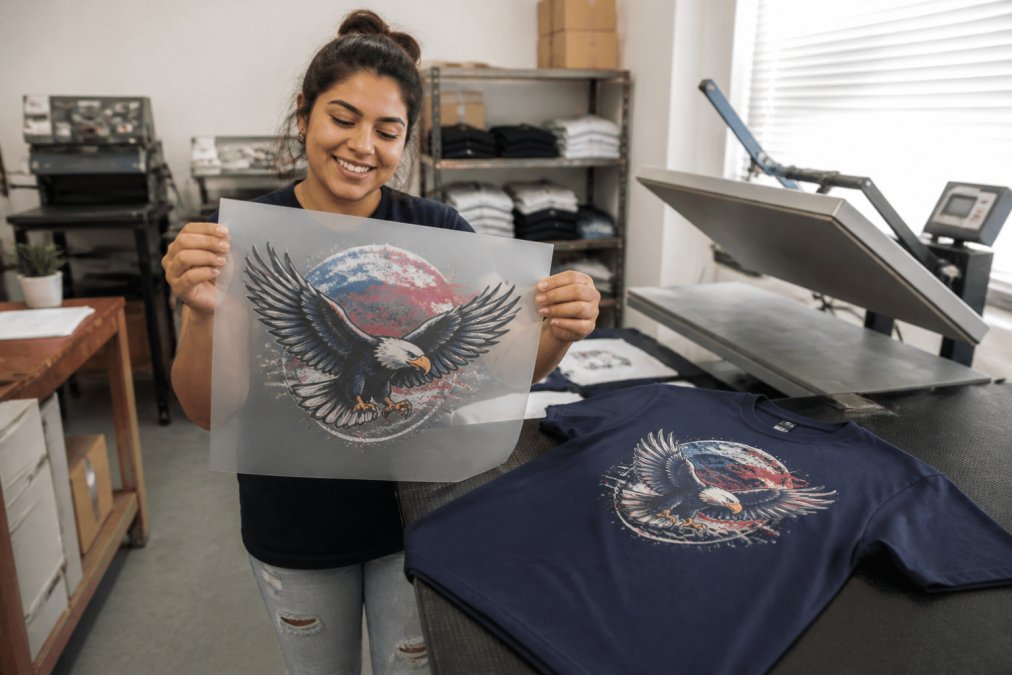
Screen Printing vs. DTF Transfers
Screen printing still wins on very large single-design runs, where the per-unit cost drops as volume climbs. DTF transfers win on everything else: small runs, multi-color art, dark garments, and fast deadlines. For a 500-piece order of one design, screen printing is efficient. For 20 pieces across three designs, DTF is the only sensible route.
| Factor | Screen Printing | DTF Transfers |
|---|---|---|
| Best volume | Large single-design runs | Small to mid runs, mixed designs |
| Color limits | Cost rises per color | Unlimited colors, no extra fee |
| Setup | Screens required | No screens, no setup fee |
| Turnaround | Slower | Faster, ready to press |
| Dark garments | Needs underbase | Prints directly, no underbase |
Custom Apparel Design Tips for Businesses
Good custom apparel design starts with restraint. A logo that works on a website often fails on a shirt because fine lines and small text disappear at print size. Keep the core mark large, use high-contrast colors, and give the design room to breathe.
Bulk Custom Apparel Ordering Guide
Bulk ordering rewards planning, but the real advantage is understanding how cost per piece changes as volume climbs. Most local businesses overpay because they order in the wrong increments or split designs across too many runs.
How to Estimate Total Cost Before You Order
A simple budget framework starts with four numbers: garment cost, decoration cost, shipping, and waste. Garment cost is the blank price multiplied by quantity. Decoration cost depends on method and design count. Shipping scales with weight and speed. Waste covers misprints, size exchanges, and extras for new hires.
Gang Sheets: The Core Bulk Cost Lever
A gang sheet packs multiple designs onto one transfer sheet, which cuts waste and cost. The 12x36 sheet at $19.99 suits a few designs or a small team. The 12x72 at $39.99 fits a full roster of names and numbers. The larger sheet lowers cost per design because you pay for one sheet instead of several.
Bulk Ordering Checklist
- Confirm final headcount and size breakdown before ordering
- Consolidate designs onto the largest gang sheet that fits
- Approve a physical or digital proof on the real garment color
- Verify decoration placement (left chest, full front, sleeve, back)
- Add 10% overage for exchanges and new hires
- Ask about rush options if the event date is tight
- Confirm delivery method and local pickup availability
Cost and Sustainability: Where Local Custom Apparel Wins
Cost per piece is only half the equation. Local custom apparel wins on total cost because it removes minimums, setup fees, and shipping delays that inflate the real price of a national order. When you can order exactly what you need, you stop paying for dead inventory.
The Real Cost of Dead Inventory
A national order with a 50-piece minimum forces you to buy 50 shirts when you need 20. The 30 extras sit in a closet, get outdated when the logo changes, or get donated. That hidden cost rarely shows up in the unit price, but it shows up in your budget. No-minimum ordering means you buy what you need, when you need it, and reorder later without penalty.
Sustainability Starts With Sourcing
Sustainability is the angle most buyers overlook. Several blanks in the catalog use U.S.-grown cotton, and many carry recycled tear-away labels, which reduces mixed-material waste at end of life. Choosing a durable, heavier fabric also extends garment life. The most sustainable shirt is the one you do not have to replace.
Care and Maintenance for Longer Life
Garment care matters here. Wash inside out in cold water and tumble low to protect the print and the fabric. Avoid fabric softener, which leaves a residue that breaks down adhesives over time. For DTF transfers, wait 24 hours after pressing before the first wash. For embroidery, turn the garment inside out to protect the stitching from abrasion.
Federal Trade Commission guidance on green marketing claims
Frequently Asked Questions
How much does custom apparel cost for a small business?
At Shirtz Plus, custom t-shirts start at $12.99, blank tees range from $5.00 to $6.75, and DTF transfers start at $3.50 for a single image. Gang sheets cost $19.99 for 12x36 or $39.99 for 12x72. Because there are no minimum order requirements, a 15-piece run is priced the same way per unit as a larger order, so small teams avoid the inflated per-shirt fees that high-minimum shops charge.
Is DTF printing or screen printing better for business uniforms?
DTF printing for business uniforms works well when you need full-color logos, small batches, or orders that change often, since there are no setup fees and unlimited color options. Screen printing is a fit for large runs of one design where per-unit cost drops with volume. Shirtz Plus offers both, plus print-and-press and mobile printing options, so you can match the method to your order size and turnaround needs.
Can I order custom apparel without a minimum order quantity?
Yes. Shirtz Plus has no minimum order requirements, so a family reunion needing 15 shirts or a small business ordering 10 polos gets the same quality and service as a 500-piece order. This matters for local businesses that want to test a design before committing to a large run, or for groups like military units and school teams that need a limited quantity of commemorative gear.
What design tips help local businesses get better custom apparel?
Keep logos simple with 2-3 colors for strong brand visibility at a distance, supply vector art when possible for clean scaling, and confirm a design proof before production. Place the logo on the left chest for polos and full front or back for t-shirts. For DTF transfers, use high-resolution files so colors match your brand. Shirtz Plus can help refine artwork if you do not have print-ready files.
How fast can a local business get custom apparel orders?
Turnaround time depends on the order size and decoration method. Shirtz Plus offers fast turnaround times with same-day and rush service available on select orders, plus a mobile printing unit that can print on-site at events. For bulk custom apparel ordering, confirm your deadline when you request a quote so the production schedule can be built around your event date.
Local businesses need branded apparel that arrives on time, matches the approved proof, and fits the actual headcount, not a vendor's minimum. Shirtz Plus handles that with no minimum order requirements, competitive pricing, and fast turnaround, plus full-service printing, print-and-press options, and a mobile printing unit that brings the press to your event. Get a quote now and put dependable custom apparel to work for your team.